Some things that worry owners of new concrete are normal, and some are real defects. This page sorts one from the other for Miami conditions, where heat, sudden rain and humidity cause most early trouble.
Why is my new concrete already cracking?
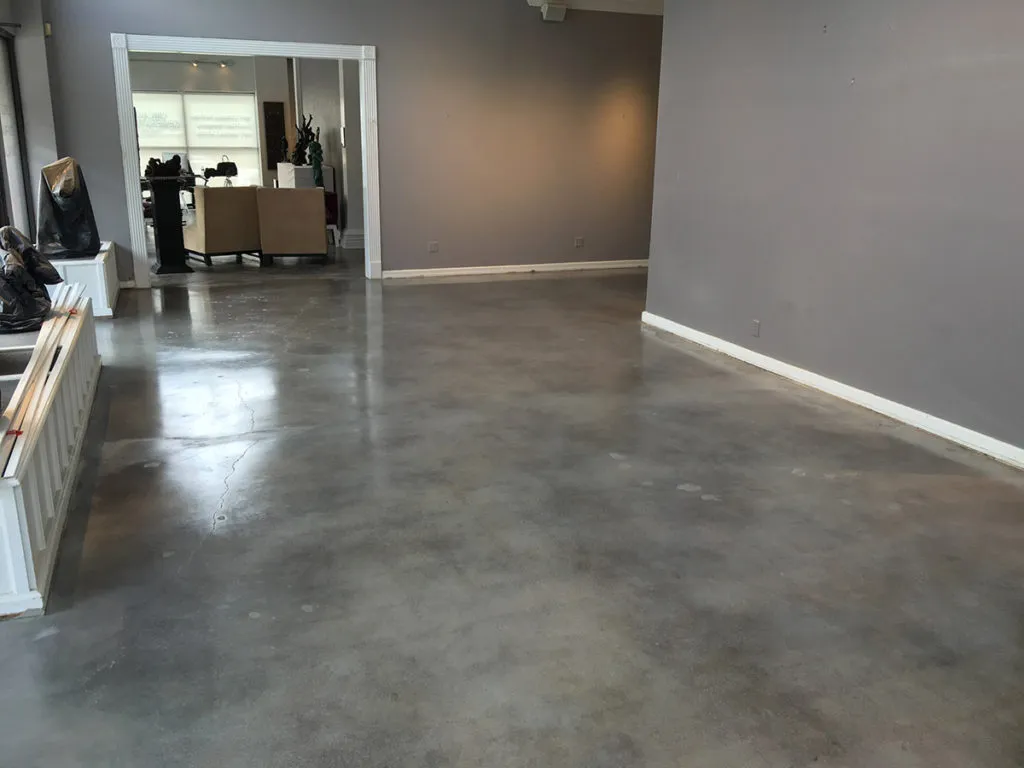
Thin, straight cracks in new concrete usually come from shrinkage as the slab dries, and that is expected. Joints are placed so the cracks form inside them. Cracks outside the joints within days point to something else: joints cut too late or too far apart, a slab that dried too fast in sun and wind, or a soft base. Hairline cracks are a matter of looks. Cracks you can fit a coin into, or with one side higher, should be raised with the contractor in writing.
Is the contractor responsible for a crack that appears weeks later?
The contractor is responsible when the crack comes from how the work was done, and not when it comes from normal shrinkage. Poor base, missing joints and thin concrete are workmanship. A fine crack running along a joint line is not. Your contract and any written warranty decide what gets fixed. Take dated photos with a tape measure in the picture and send them by email so there is a record.
Why does my new concrete have dark and light patches?
Dark and light patches in the first weeks are mostly uneven drying. In Miami one end of a slab may sit in full sun while the other stays shaded and damp under a tree, and they cure at different speeds. Concrete from two different truckloads can also differ slightly. Most of this fades over a few months. Blotches caused by water added to the surface, or by hard troweling in some spots, tend to stay.
What happens if it rains on fresh concrete?
If it rains on fresh concrete in the first few hours, the surface can be damaged. If the rain comes after the concrete has set, it does little harm and can even help curing. Heavy rain on a wet surface washes cement out of the top and leaves it weak, sandy and pitted. Summer storms here build fast in the afternoon, so pours are started early and plastic sheeting is kept ready. If your slab was caught, wait until it dries, then scratch it with a screwdriver. A surface that powders easily needs repair.
There are footprints and low spots, or my new pad is out of level. Is that acceptable?
No. Footprints, trowel marks and low spots that hold water are finishing faults, not features. Lay a straight board on the slab after rain and mark where puddles sit. Small defects can be ground or covered with a thin overlay. A wide area that ponds water against the house is a reason to ask for that section to be redone.
Are control joints really necessary?
Yes. Control joints are the planned weak lines that tell the slab where to crack. Leave them out and the slab chooses its own lines. On a normal 4 inch slab they are spaced roughly 8 to 12 feet apart and cut to about a quarter of the slab depth. A contractor who offers a joint-free driveway to make it look cleaner is not doing you a favor.
The contractor says he will come back and saw-cut the joints next week. Is that fine?
No, a week is too late. Saw-cut joints have to go in as soon as the concrete can take the saw without tearing, which in Miami heat is often the same day and no later than the next morning. A slab left uncut for a week has usually cracked already, and a cut made after that does nothing useful.
I found out it was poured without rebar or mesh. Is that a problem?
It depends on what was promised and what the slab is for. A patio or walk poured without rebar on a firm rock base may perform well. A driveway, or any slab over fill, is better with steel, because steel holds cracks tight and keeps the two sides level. If the quote or the permit drawings listed reinforcement and none was placed, that is a breach and you should raise it in writing. Steel cannot be added after the pour.
What can I do if the contractor will not come back to fix it?
If the contractor will not come back, build a paper record and then use the official routes. Write down the defects with dates and photos and send a letter asking for repair by a set date. Keep any unpaid balance until it is resolved, within what your contract allows. If the contractor holds a licence, complain to the body that issued it. State licences sit with the Florida Department of Business and Professional Regulation. For money, the county court has a small claims division. An attorney can advise on larger sums.
My new stamped concrete is slippery, or it has gone cloudy, faded or peeling. Can that be fixed?
Yes. Stamped concrete turns slippery when a glossy sealer fills the texture, and Miami gets rain most summer afternoons. The cure is a grip additive, a fine grit, mixed into a fresh coat of sealer. Around a pool or on a sloped drive, ask for that from the start and choose a pattern with real texture.
A cloudy or white film means moisture is trapped under the sealer. That is common here, because the ground is damp and the air is humid, and sealer put on too thick or too soon cannot breathe. Fading comes from strong sun on the color. Peeling follows too many coats. The usual repair is to strip or chemically reflow the sealer and put it back in thin coats on a dry day.
The surface started flaking within the first year. Why?
Flaking in the first year points to a weak top layer, since Miami has no first winter freeze to blame. The causes are water sprinkled on to make finishing easier, finishing while water was still rising, a rain shower at the wrong moment, or no curing in hot sun. It is a workmanship matter. Report it to the contractor while it is still within any warranty period.
It was poured in extreme heat and now looks bad. What went wrong?
Concrete poured in extreme heat sets before the crew can finish it properly. The results are a rough or torn surface, fine crazing cracks and cold joints where one load stiffened before the next arrived. In Miami this is avoidable. Crews start at dawn, wet the base, bring enough hands and begin curing at once. Fine crazing is only a matter of looks. A weak, dusty surface is not.
The stamped pattern is crooked and uneven. Do I have to make the final payment?
You can reasonably hold the final payment while a real defect is being sorted out, as far as your contract allows. Photograph the crooked lines and uneven joints and ask in writing how they will be corrected. Be aware that stamping cannot be redone once the slab is hard. The choices are a stamped overlay, a color fix, a price reduction or replacement. Agree one in writing before the final balance changes hands.
The crew left ruts, washout and splatter, and the forms are still on. Who deals with it?
The contractor should. Ruts from a truck or buggy, a patch of washout where the chute was rinsed and gray splatter on walls or pavers are all part of the mess of a pour, and cleanup belongs in the contract. Ask before the job where the truck will wash out. Splatter comes off far more easily in the first day or two than later.
Outdoor slabs are not meant to be dead level. They are sloped a little, commonly about an eighth to a quarter inch per foot, so rain drains. A pad that is out of level in the wrong direction, or one that rocks a shed or an air conditioning unit, is a fault. Check it with a long level and tell the contractor what you measure.
Forms are normally pulled a day or two after the pour. Left for weeks, wood forms swell in our rain and stick, and removing them can chip the slab edge. It is untidy and it draws termites, but it rarely harms the slab. Ask the contractor to remove them and to backfill along the edges, since an edge left unsupported can wash out.
For a price on your own property, ask for a free on-site estimate with a written quote. Call (786) 705-4727, or text a photo of the concrete to the same number.